all names (12)
Names, authorship and dates from Index Fungorum.
- BasidiomycotaPhylum
- └─ AgaricomycetesClass
- └─ PolyporalesOrder
- └─ PodoscyphaceaeFamily
- └─ PodoscyphaGenus
Higher ranks from Catalogue of Life (COL26.9 XR).
not recorded
Saprobic on dead or buried wood and roots, frequently at the base of trees; in Europe mostly in warm, sheltered places such as botanic gardens and greenhouses
⚠ Before you pickWild fungi may be taken in small quantities for your own use (§39(3) BNatSchG) — but not in nature reserves or national parks, on closed land or on farmland in use, and never for sale (§39(4)). In Bavaria this right is anchored in Art. 141(3) of the state constitution and is limited to locally customary amounts; the competent authority is the district nature-conservation authority (untere Naturschutzbehörde). Local signs and ordinances come first.
Species protection from BArtSchV Annex 1 and §2(1), retrieved 2026-10-15; Red List from Dämmrich et al. (2016) (BfN / Rote-Liste-Zentrum). Not legal advice — local rules and signage may be stricter. BArtSchV Annex 1 · Red List data
not recorded
Inedible — thin, leathery and tough
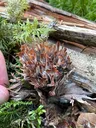
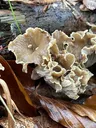
- ▸ Thin, leathery, funnel- or trumpet-shaped fruit bodies ("wine glasses"), often fused into a rosette, with wavy, lobed rims
- ▸ Upper surface orange-brown to chestnut with concentric zones, paler at the edge; underside smooth, cream to grey
- ▸ Underside is smooth and fertile like a Stereum — there are no pores, gills or spines
- ▸ Grows from dead or buried wood, often at the base of living trees; tough and papery when dry
A mainly tropical and subtropical species whose stacked funnels are unmistakable in shape; it was originally described as Stereum petalodes. The similar Podoscypha multizonata of warmer parts of Europe forms flatter, more clearly zoned rosettes.
This page draws its species data from Wikidata.