all names (17)
Names, authorship and dates from Index Fungorum.
- BasidiomycotaPhylum
- └─ AgaricomycetesClass
- └─ AgaricalesOrder
- └─ StrophariaceaeFamily
- └─ StrophariaGenus
Higher ranks from Catalogue of Life (COL26.9 XR).
%20--%3e%3csvg%20xmlns:svg='http://www.w3.org/2000/svg'%20xmlns='http://www.w3.org/2000/svg'%20version='1.0'%20width='342'%20height='342'%20id='svg2'%3e%3cdefs%20id='defs5'%20/%3e%3cg%20transform='translate(39.9975,49.5085)'%20id='layer1'%3e%3cpath%20d='M%20104.44256,227.17068%20C%20104.76135,219.57553%20105.924,202.19243%20107.02622,188.54152%20C%20108.55863,169.56282%20113.08718,103.4429%20113.08718,100.0474%20C%20113.08718,99.740396%2088.756339,99.645316%2059.018639,99.836096%20L%204.9501286,100.18299%20L%203.2864786,96.493266%20C%201.0351686,91.500166%201.8110286,81.274216%205.0477486,73.279506%20C%2010.644089,59.456476%2026.130699,40.917156%2040.213759,31.181546%20C%2052.398359,22.758326%2076.569079,12.145446%2094.745989,7.2375357%20C%20101.70725,5.3579457%20113.71349,2.5068657%20130.72887,2.0736957%20C%20153.34906,1.4815757%20168.07497,4.6405157%20186.96307,9.9107357%20C%20230.03988,21.930146%20250.54874,35.827436%20258.08095,58.101916%20C%20261.10886,67.056136%20260.51457,78.953286%20256.63421,87.063786%20C%20252.0591,96.626416%20255.65153,95.992106%20199.8671,97.087096%20L%20150.91281,98.048006%20L%20150.24061,103.42814%20C%20149.8709,106.3872%20150.12706,128.55002%20150.80984,152.67881%20C%20152.21558,202.35627%20152.5805,236.22273%20151.71948,237.09912%20C%20150.68082,238.15629%20136.45308,239.5867%20119.96464,240.29162%20L%20103.86293,240.98%20L%20104.44256,227.17068%20z%20'%20style='fill:%23552860;fill-opacity:1;stroke:black;stroke-width:3;stroke-miterlimit:4;stroke-dasharray:none;stroke-opacity:1'%20id='path1893'%20/%3e%3c/g%3e%3c/svg%3e)
%20--%3e%3cpath%20class='cap-stem'%20d='%20M%20290%20290%20L%20245%20290%20C%20245%20180,%20245%20150,%20240%20140%20C%20210%20140,%2060%20150,%2025%20150%20C%2010%20150,%2020%20110,%2080%2070%20C%20140%2030,%20230%2020,%20290%2030%20Z%20'%20/%3e%3c!--%20Adnate%20Gill%20(Attached%20directly%20to%20the%20stem)%20--%3e%3cpath%20class='gill'%20d='%20M%2032%20153%20C%2070%20175,%20170%20195,%20241%20180%20L%20241%20142%20C%20200%20142,%20100%20148,%2032%20153%20Z%20'%20/%3e%3c/svg%3e)
;stroke:%23000;stroke-width:2'%20/%3e%3cpath%20d='M%20163.4,15.29%20166.7,63%20c%2023.8,9.5%2053,21.94%2069.4,34.44%2032.8,-2.63%2054.3,-9.3%2067.3,-18.25%20l%209.5,-6.5%20C%20258.9,57.81%20200.5,25.76%20163.4,15.29%20z'%20style='fill-opacity:0.166'%20/%3e%3cpath%20d='m%20177.4,308%20c%205.5,-61%206.127,-222.8%202.9,-275.3%20-1.673,-27.22%20-70.64,-22.82%20-70.3,6.34%201.1,98.26%2011.6,143.6%20-11.5,269'%20style='fill:url(%23linearGradient2);stroke:%23000;stroke-width:2'%20/%3e%3crect%20width='297'%20height='297'%20x='1.5'%20y='1.5'%20id='rect4146'%20style='fill:none;stroke:%23000;stroke-width:3'%20/%3e%3c/svg%3e)
Saprotrophic on rotting wood, wood-chip mulch, grassy woodland, roadside verges and parks, spring to autumn
⚠ Before you pickWild fungi may be taken in small quantities for your own use (§39(3) BNatSchG) — but not in nature reserves or national parks, on closed land or on farmland in use, and never for sale (§39(4)). In Bavaria this right is anchored in Art. 141(3) of the state constitution and is limited to locally customary amounts; the competent authority is the district nature-conservation authority (untere Naturschutzbehörde). Local signs and ordinances come first.
Species protection from BArtSchV Annex 1 and §2(1), retrieved 2026-10-15; Red List from Dämmrich et al. (2016) (BfN / Rote-Liste-Zentrum). Not legal advice — local rules and signage may be stricter. BArtSchV Annex 1 · Red List data

Not recommended — widely reported as poisonous, though a few European guides list it as edible with a mildly spicy taste; treat as inedible
- ▸ Vivid blue-green, glutinous cap 2–8 cm across, sprinkled with white veil remnants that sit as flecks near the margin
- ▸ The colour fades or washes off with rain and age, turning yellow-ochre — old caps lose the blue-green entirely
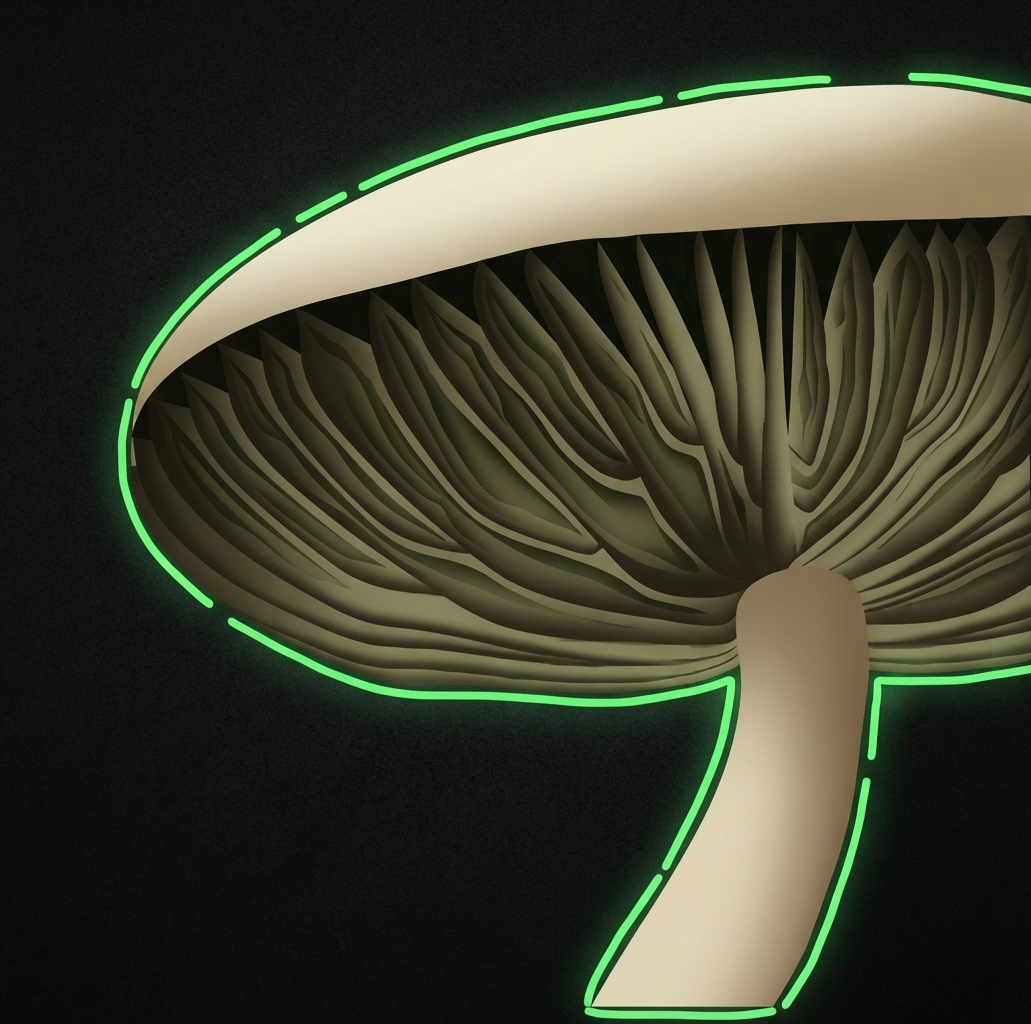
- ▸ White stem of even thickness with a fragile dark ring; below the ring fine white scales
- ▸ Gills white at first, then clay-brown, often with a paler edge; spore print brownish-purple
Told apart from lookalikes by the slimy blue-green cap with white flecks combined with the dark ring on the white stem. Reported poisonous in many guidebooks, while a few European sources call it edible — with the toxic constituents undescribed and the effects unclear, it is not worth collecting. Wood-chip mulch in gardens and parks is its favourite substrate.

This page draws its species data from Wikidata.