╔═ Photos
[ map ]47.4940°N 11.1175°E
╔═ Names
Scientific nameXylaria hypoxylon
Common namesCandlesnuff Fungus
╔═ Nomenclature
Accepted nameXylaria hypoxylon(L.) Grev., 1824
BasionymClavaria hypoxylonL., 1753
all names (29)
Variations
Xylaria hypoxylonsubsp.hypoxylon(L.) Grev., 1824
Xylaria hypoxylonvar.hypoxylon(L.) Grev., 1824
Xylaria hypoxylonf.hypoxylon(L.) Grev., 1824
Other names
Cordyceps hypoxylon(L.) Fr., 1818
Cordylia hypoxylon(L.) Fr., 1818
Sphaeria hypoxylon(L.) Pers., 1796
Xylosphaera hypoxylon(L.) Dumort., 1822
Hypoxylon cornutumvar.ramosum(Dicks.) Gray, 1821
Sphaeria adscendensFr., 1830
Sphaeria cupressiformisWoodw., 1792
Sphaeria hypoxylonvar.cupressiformis(Woodw.) Pers., 1801
Sphaeria hypoxylonvar.pedataFr., 1816
Sphaeria ramosaDicks., 1801
Xylaria adscendens(Fr.) Fr., 1851
Xylaria cupressiformis(Woodw.) J. Kickx f., 1835
Xylaria hypoxylonf.tropicaSyd., P. Syd. & E.J. Butler, 1911
Xylaria hypoxylonsubsp.adscendens(Fr.) D. Hawksw., 1973
Xylaria hypoxylonvar.bowmaniiF. Muell., 1881
Xylaria hypoxylonvar.cupressiformis(Woodw.) Pers. ex Sacc., 1882
Xylaria hypoxylonvar.erythraeaBacc., 1917
Xylaria hypoxylonvar.mucronataBerk. & Broome, 1873
Xylaria hypoxylonvar.pedata(Fr.) Sacc., 1882
Xylaria hypoxylonvar.subtrachelina(Henn.) P.M.D. Martin, 1970
Xylaria hypoxylonvar.uviformisMont., 1882
Xylaria subtrachelinaHenn., 1904
Xylosphaera adscendens(Fr.) Dennis, 1958
Xylosphaera hypoxylonsubsp.adscendens(Fr.) Dennis, 1961

Names, authorship and dates from Index Fungorum.

╔═ Classification
  • AscomycotaPhylum
  • └─ SordariomycetesClass
  • └─ XylarialesOrder
  • └─ XylariaceaeFamily
  • └─ XylariaGenus

Higher ranks from Catalogue of Life (COL26.9 XR).

╔═ Morphology

not recorded

╔═ Ecology

Saprobic on dead and decaying stumps and logs of broadleaves, especially beech; also on buried wood

╔═ Foraging status
Species protectionNo species-specific restriction under federal law
Red List (Germany)* — Not threatened

⚠ Before you pickWild fungi may be taken in small quantities for your own use (§39(3) BNatSchG) — but not in nature reserves or national parks, on closed land or on farmland in use, and never for sale (§39(4)). In Bavaria this right is anchored in Art. 141(3) of the state constitution and is limited to locally customary amounts; the competent authority is the district nature-conservation authority (untere Naturschutzbehörde). Local signs and ordinances come first.

Species protection from BArtSchV Annex 1 and §2(1), retrieved 2026-10-15; Red List from Dämmrich et al. (2016) (BfN / Rote-Liste-Zentrum). Not legal advice — local rules and signage may be stricter. BArtSchV Annex 1 · Red List data

╔═ Edibility

not recorded

Inedible — too small and tough to be of any culinary value

╔═ Key Features
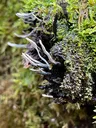
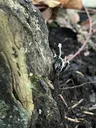
  • ▸ Antler- or club-shaped, flattened, often branched fruit bodies like a tiny stag's horn
  • ▸ Black, carbonaceous surface with powdery whitish-grey tips while young
  • ▸ The pale tips darken as the sexual fruit bodies mature
  • ▸ Grows in dense tufts on dead hardwood stumps and logs
╔═ Notes

One of the most common decomposers of hardwood; the pale 'snuff' on the tips is the asexual conidial stage, which turns to sooty black as the perithecia mature.