Names, authorship and dates from Index Fungorum.
- AscomycotaPhylum
- └─ SordariomycetesClass
- └─ XylarialesOrder
- └─ XylariaceaeFamily
- └─ XylariaGenus
Higher ranks from Catalogue of Life (COL26.9 XR).
not recorded
Saprobic on dead logs, branches and stumps of broadleaves, favouring sycamore (Acer pseudoplatanus) and beech; causes a soft rot; found most of the year
⚠ Before you pickWild fungi may be taken in small quantities for your own use (§39(3) BNatSchG) — but not in nature reserves or national parks, on closed land or on farmland in use, and never for sale (§39(4)). In Bavaria this right is anchored in Art. 141(3) of the state constitution and is limited to locally customary amounts; the competent authority is the district nature-conservation authority (untere Naturschutzbehörde). Local signs and ordinances come first.
Species protection from BArtSchV Annex 1 and §2(1), retrieved 2026-10-15; Red List from Dämmrich et al. (2016) (BfN / Rote-Liste-Zentrum). Not legal advice — local rules and signage may be stricter. BArtSchV Annex 1 · Red List data
Inedible — the flesh is far too hard and tough
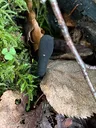
- ▸ Slender, black, club-shaped fruit bodies (2.5–6.5 cm tall) on a distinct narrow sterile stalk, usually unbranched
- ▸ Surface greyish to brownish when young and dusted with pale conidia, blackening and cracking into scales with age
- ▸ Interior flesh white and very tough
- ▸ Differs from Xylaria polymorpha by its longer stalk, more slender clubs and smaller spores (12–16 µm against 20–32 µm)
- ▸ Grows directly from dead hardwood, especially sycamore maple and beech
Named for its long stalk (longipes). The maple wood it decays is part of the "fungal violin" research, where controlled fungal decay was shown to shape the acoustic properties of instrument wood.
This page draws its species data from Wikidata.