all names (8)
Names, authorship and dates from Index Fungorum.
- BasidiomycotaPhylum
- └─ AgaricomycetesClass
- └─ ThelephoralesOrder
- └─ BankeraceaeFamily
- └─ BoletopsisGenus
Higher ranks from Catalogue of Life (COL26.9 XR).
not recorded
Ectomycorrhizal with spruce (Picea), in rich, grassy or mossy conifer forest on mull or raw humus; late summer to autumn
⚠ Before you pickWild fungi may be taken in small quantities for your own use (§39(3) BNatSchG) — but not in nature reserves or national parks, on closed land or on farmland in use, and never for sale (§39(4)). In Bavaria this right is anchored in Art. 141(3) of the state constitution and is limited to locally customary amounts; the competent authority is the district nature-conservation authority (untere Naturschutzbehörde). Local signs and ordinances come first.
Species protection from BArtSchV Annex 1 and §2(1), retrieved 2026-10-15; Red List from Dämmrich et al. (2016) (BfN / Rote-Liste-Zentrum). Not legal advice — local rules and signage may be stricter. BArtSchV Annex 1 · Red List data
not recorded
Inedible — mild at first but with a soapy, slowly bitter aftertaste; rare, so leave it in place
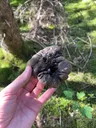
- ▸ A fleshy, annual polypore with the habit of a bolete, but the tube layer cannot be peeled from the cap flesh
- ▸ Cap dark grey to black-brown, smooth and matt, with a faint magenta tinge when fresh; young specimens paler towards the margin
- ▸ Pore surface creamy white, taking on a pale lilac-grey or smoky grey-brown tint, bruising pinkish; pores 1–3 per mm, slightly decurrent
- ▸ All parts stain a permanent sepia-black with potassium hydroxide (KOH)
- ▸ Central to eccentric stem with a whitish apex and orange mycelium at the base; fruit bodies grow in dense clusters
Easily confused with the pine-associated Boletopsis grisea, which is silvery grey, more compact and less fragile, and prefers dry sandy heath. Despite its bolete-like look, DNA places the genus near the toothed fungi such as Sarcodon.
This page draws its species data from Wikidata.