No common name
all names (10)
Names, authorship and dates from Index Fungorum.
- BasidiomycotaPhylum
- └─ AgaricomycetesClass
- └─ RussulalesOrder
- └─ HericiaceaeFamily
- └─ HericiumGenus
Higher ranks from Catalogue of Life (COL26.9 XR).
not recorded
Saprobe and weak parasite on conifer deadwood, above all silver fir (Abies alba), in cool, humid montane mixed forest; late summer to November
⚠ Before you pickWild fungi may be taken in small quantities for your own use (§39(3) BNatSchG) — but not in nature reserves or national parks, on closed land or on farmland in use, and never for sale (§39(4)). In Bavaria this right is anchored in Art. 141(3) of the state constitution and is limited to locally customary amounts; the competent authority is the district nature-conservation authority (untere Naturschutzbehörde). Local signs and ordinances come first.
Species protection from BArtSchV Annex 1 and §2(1), retrieved 2026-10-15; Red List from Dämmrich et al. (2016) (BfN / Rote-Liste-Zentrum). Not legal advice — local rules and signage may be stricter. BArtSchV Annex 1 · Red List data
not recorded
Edible when young, but rare and legally protected in parts of Europe; best left in place
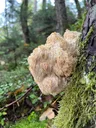
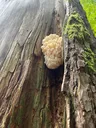
- ▸ White, coral-like fruit body of many repeatedly forking branches, up to 30 cm or more across, ageing cream to yellowish
- ▸ Long white spines (up to about 20 mm) hanging in tufts from the branch tips, unlike the spines running along the branches of the Ästiger Stachelbart
- ▸ Firm, fleshy white flesh with a mild, pleasant smell and taste
- ▸ Grows on dead wood of conifers, especially silver fir, on standing and fallen trunks and stumps
Confirmed as a species distinct from Hericium coralloides by sexual incompatibility studies in 1983; strongly tied to silver fir and red-listed as threatened across much of Europe.
This page draws its species data from Wikidata.