all names (8)
Names, authorship and dates from Index Fungorum.
- BasidiomycotaPhylum
- └─ AgaricomycetesClass
- └─ RussulalesOrder
- └─ RussulaceaeFamily
- └─ RussulaGenus
Higher ranks from Catalogue of Life (COL26.9 XR).
not recorded
Mycorrhizal with broadleaved trees, especially oak, birch and linden, often on acid, sandy soil in parks and waysides
⚠ Before you pickWild fungi may be taken in small quantities for your own use (§39(3) BNatSchG) — but not in nature reserves or national parks, on closed land or on farmland in use, and never for sale (§39(4)). In Bavaria this right is anchored in Art. 141(3) of the state constitution and is limited to locally customary amounts; the competent authority is the district nature-conservation authority (untere Naturschutzbehörde). Local signs and ordinances come first.
Species protection from BArtSchV Annex 1 and §2(1), retrieved 2026-10-15; Red List from Dämmrich et al. (2016) (BfN / Rote-Liste-Zentrum). Not legal advice — local rules and signage may be stricter. BArtSchV Annex 1 · Red List data
not recorded
Edible — a decent table mushroom among the mild brittlegills
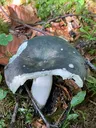
- ▸ Dull blue-green to grey-green cap with a whitish bloom (pruina) that looks frosted or even mouldy
- ▸ Brittle, white to cream gills and a firm white stem, often with ochre spots at the base
- ▸ Mild taste, the gills occasionally slightly hot
- ▸ Cream spore print
Mild brittlegills are edible — the rule is: take a taste test, only mild specimens go in the basket.
This page draws its species data from Wikidata.